

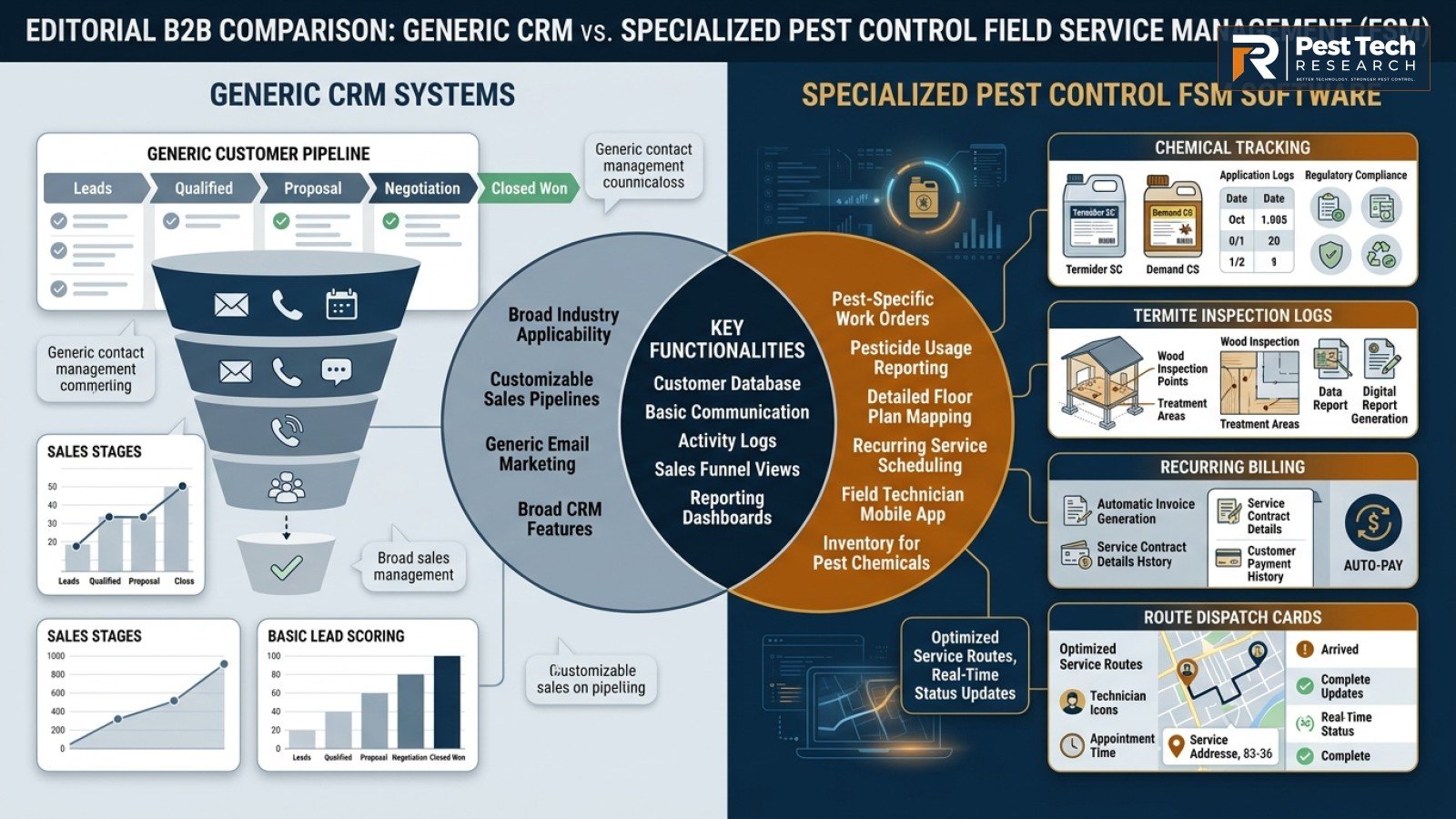
A general CRM (such as HubSpot, Salesforce, or Zoho) manages sales pipelines, contacts, and email communication, but completely lacks the field operational capabilities required to run a pest control company. A pest control business legally and operationally requires specialized Pest Control Software (Field Service Management) that handles EPA chemical application logs, structural termite warranties, recurring subscription billing, technician mobile routing, and state regulatory reporting. Generic CRMs should only be used as complementary marketing layers, never as primary operational cores.
- Chemical Regulatory Barrier: State structural pest boards mandate recording chemical trade names, EPA registration numbers, target pests, dilution rates, and wind/weather conditions—which generic CRMs cannot support natively.
- Recurring Subscription Billing: Pest control operates on bi-monthly, quarterly, and seasonal contract cycles with automated credit card tokenization that standard CRMs struggle to automate.
- Property vs. Customer Hierarchy: Pest operations treat the physical property (crawlspace conditions, termite history, pet notes) as distinct from the current billing contact (tenant vs owner).
- The Transition Threshold: Solo operators can survive on generic scheduling for 6–12 months, but adding a second truck or commercial accounts necessitates specialized pest software.
The Terminology Confusion in Pest Operations
Many new pest control entrepreneurs and expanding operators ask: “Can I just run my company on HubSpot or Jobber, or do I need specialized software like FieldRoutes or PestPac?”
The confusion stems from software vendors using the term “CRM” (Customer Relationship Management) interchangeably with “FSM” (Field Service Management) and “Pest Operations Software.” To make a sound investment, operators must understand the fundamental architectural differences.
The 4 Operational Pillars Unique to Pest Control
1. Pesticide Usage & Regulatory Compliance
Pest control is a heavily regulated chemical application industry. Every state structural pest control board requires applicators to generate and store detailed treatment records for 2 to 7 years. These records must capture:
- Exact target pest identified (e.g., *Reticulitermes flavipes*, *Blattella germanica*).
- Chemical product trade name and federal EPA registration number.
- Total concentrate volume applied and finished dilution percentage.
- Application method (crack & crevice, exterior perimeter band, sub-slab injection).
- Wind velocity, temperature, and ambient weather conditions at treatment time.
Generic CRMs and general field service tools (like basic Housecall Pro or Jobber setups) require cumbersome manual custom-field workarounds that frequently fail state audits. Specialized platforms (PestPac, FieldRoutes, GorillaDesk, Briostack) generate compliant chemical reports automatically during mobile checkout.
2. The Complex Customer vs. Property Relationship
In standard B2B sales, a CRM tracks a Person at a Company. In pest control, the relationship is decoupled:
The Customer: The entity paying the bill (Property Management Company, Landlord, HOA, or Tenant).
The Property: The physical structure being treated (123 Oak Street), which retains its subterranean termite history, bait station GPS coordinates, dog warnings, and gate codes even when tenants change.
Specialized pest control software architectures model this hierarchy natively, ensuring historical chemical treatments remain tied to the parcel across successive homeowners.
3. Recurring Subscription & Automated Route Sequencing
Residential pest control relies on recurring quarterly, bi-monthly, or monthly service contracts. Unlike one-off plumbing or HVAC repairs, pest software must automatically generate hundreds of recurring service work orders, cluster them into geographic technician routes, and trigger automated credit card autopay upon completion.
4. Structural Graphing & Termite Inspections
WDO/WDI (Wood-Destroying Organism) inspections for real estate transactions require standardized official forms (such as the federal HUD NPMA-33 or Texas OIR-120G) alongside scale structural diagrams indicating subterranean termite shelter tubes, moisture damage, and past treatment points. Generic CRMs cannot generate compliant structural inspection graphs.
| Core Operational Requirement | Generic CRM (HubSpot/Zoho) | General FSM (Jobber/Housecall) | Specialized Pest Software (PestPac/FieldRoutes/GorillaDesk) |
|---|---|---|---|
| Sales Pipeline & Email Sequences | Exceptional | Basic | Basic to Moderate |
| Pesticide EPA Chemical Tracking | Not Supported | Manual Workarounds | Native, State-Compliant |
| Property vs Contact Hierarchy | Poor | Moderate | Native Entity Architecture |
| Automated Recurring Route Clustering | Not Supported | Moderate | Advanced Geographic Density |
| Termite WDO Graphing / State Forms | Not Supported | Not Supported | Native Integration |
When Does a Pest Business Need Specialized Software?
We recommend following this transition framework based on fleet capacity and service offerings:
- Solo Operator Doing General Pest Only: A modern general FSM (such as GorillaDesk Basic or Jobber) is sufficient if chemical logs are simple and termite warranties are not offered.
- 2 to 5 Trucks with Termite & Recurring Accounts: A specialized pest platform is mandatory. The administrative overhead of manually tracking chemical logs, state reporting, and route density across multiple trucks will rapidly cost more than the software subscription.
- Enterprise Fleets (10+ Trucks) with Inbound Marketing Teams: Many mature pest enterprises run a hybrid stack: a specialized pest FSM (like FieldRoutes or PestPac) as the operational backend, paired with an integrated marketing CRM (like HubSpot or ActiveCampaign) via API webhooks to drive inbound sales funnels.
Frequently Asked Questions
Can I integrate HubSpot with my pest control software?
Yes. Platforms with open REST APIs or Zapier connectors can sync newly captured web leads from HubSpot into your operational pest software automatically. Explore our Tech Stack Builder to model integrated architectures.
- Association of American Pesticide Control Officials (AAPCO). State Structural Regulatory Recordkeeping Guidelines. Verified 2026.
- HUD Form NPMA-33: Wood Destroying Insect Inspection Report Regulatory Requirements.
- Pest Tech Research Core Operational Workflow Model (AGENTS.md Persistent Standard).