

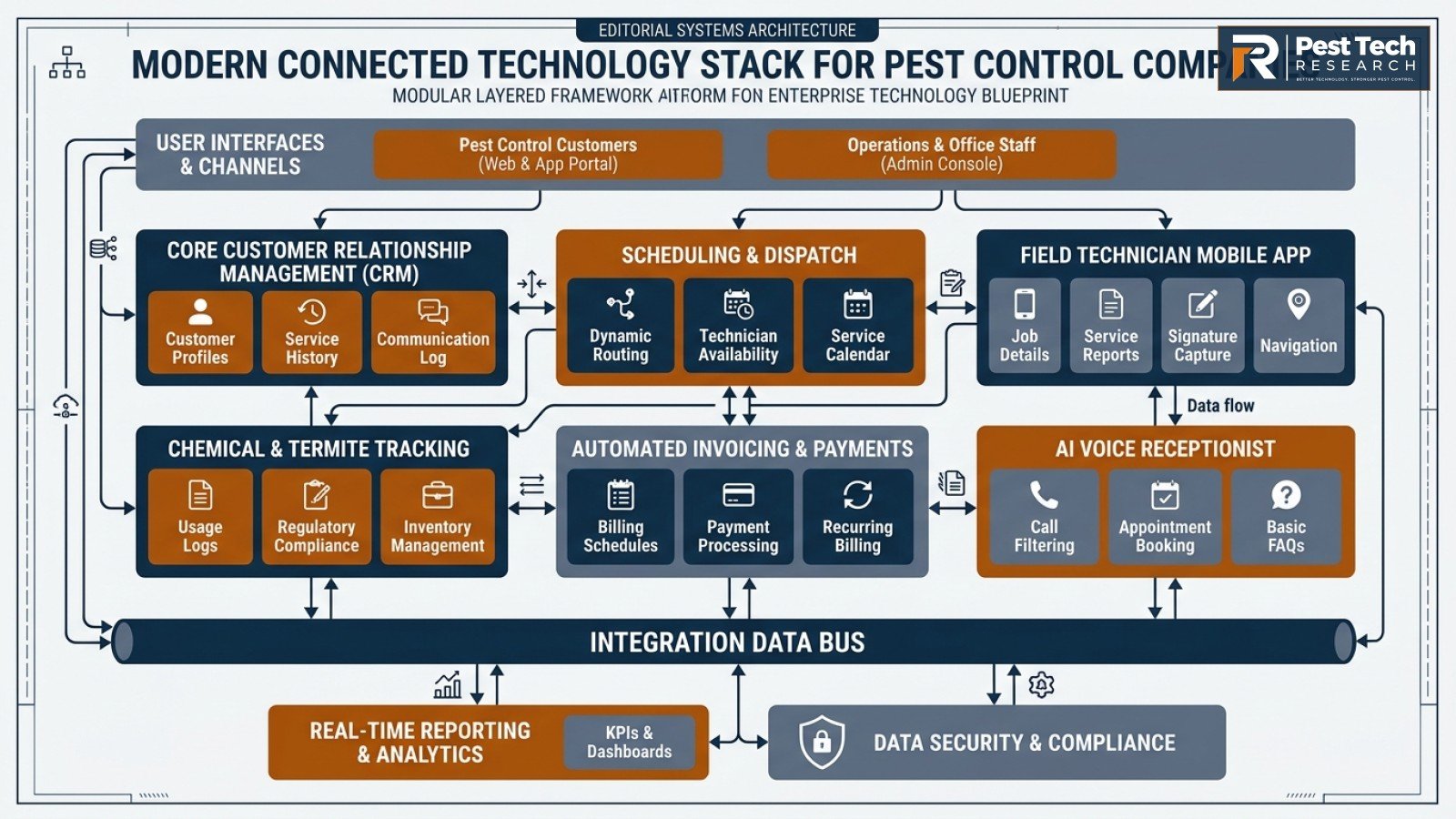
A modern pest control technology stack is not a random collection of disconnected apps; it is an integrated systems architecture built directly around the 11-stage operational workflow pipeline: Customer → Property → Lead → Service → Appointment → Technician → Treatment → Invoice → Payment → Recurring Service → Follow-up. Growing companies require five core technological layers: Operational Core FSM, Mobile Technician Execution, Automated Telephony & Speed-to-Lead, Payment Processing & Autopay, and Business Intelligence Dashboards. Unifying these layers eliminates administrative data re-entry, accelerates technician stop-completion velocity, and protects recurring subscription equity.
- The Workflow Dictates the Stack: Software exists to serve the operational customer journey—never alter physical field workflows to fit rigid software limitations.
- Integration Over All-in-One: All-in-one software suites often possess weak secondary modules; connecting best-of-breed tools via open REST APIs yields superior operational agility.
- Stage-Based Architecture: What works for a 1-truck solo operator will break at 5 trucks, and an enterprise multi-branch stack will bankrupt a 2-truck startup.
- Data Portability Protects Equity: Your customer database, treatment histories, and recurring autopay tokens constitute the core valuation of your pest company.
- Automated Handoffs Eliminate Leakage: Manual data transcription between inspection estimates, scheduling grids, and billing invoices introduces a 4% to 8% administrative error rate.
Mapping Technology to the 11-Stage Pest Workflow
At Pest Tech Research, we evaluate all technology through our persistent operational framework. Every tool in your software stack must cleanly own one or more stages of this sequence without creating manual data re-entry:
Customer (Contact Entity) → Property (Physical Structure & Pest History) → Lead (Inquiry & Qualification) → Service (Scope of Work & Agreement) → Appointment (Calendar Booking) → Technician (Dispatch & Routing) → Treatment (Chemical Application & Photos) → Invoice (Billing Generation) → Payment (Autopay & Tokenization) → Recurring Service (Next Cycle Generation) → Follow-up (Retention & Review).
The 5 Layers of the Modern Pest Tech Stack
Layer 1: Core Field Service Management (FSM / CRM)
The central source of truth for your business. It maintains customer records, property structures, service contracts, recurring schedules, and administrative reporting. It must natively support the decoupled customer-versus-property data model, ensuring historical chemical treatments remain tied to the parcel across successive homeowners.
- Examples: FieldRoutes, PestPac, GorillaDesk, Briostack.
Layer 2: Mobile Field Execution & Chemical Compliance
The field technician’s interface on iOS or Android tablets/smartphones. It must operate flawlessly offline in crawlspaces and remote rural locations, allowing technicians to view route stops, log chemical trade names and EPA numbers, capture customer signatures, and record site photos. When the device regains signal, it must seamlessly sync completed work orders without duplicating invoice numbers.
Layer 3: Communication & Inbound Call Capture
The front-door customer acquisition layer. Incorporates VoIP tracking numbers, missed call text-back, and conversational AI voice receptionists to ensure zero unhandled calls during peak hours. Connecting telephony directly to your FSM ensures that caller ID matches active accounts instantly, presenting the CSR or AI with the caller’s complete treatment history.
Layer 4: Billing, Autopay & Merchant Processing
Automating recurring revenue collection. High-efficiency pest businesses maintain over 85% of residential subscribers on automatic credit card tokenization or ACH debits, drastically cutting accounts receivable labor. Ensure your merchant tokenization vault is portable so you are never held hostage by your software vendor’s proprietary payment processor.
Layer 5: Business Intelligence & Marketing Automation
Analytics tools that calculate customer acquisition cost (CAC), technician stop-completion velocity, cancellation churn rates, and trigger seasonal re-engagement campaigns across email and SMS.
| Company Stage | Truck Fleet Size | Recommended Stack Architecture | Est. Monthly Tech Spend |
|---|---|---|---|
| Solo Operator | 1 Truck (0–400 accounts) | GorillaDesk Basic or Jobber + OpenPhone (missed call text-back) + QuickBooks Online. | $150 – $350 / mo |
| Growth Fleet | 2 to 6 Trucks (500–2,500 accounts) | FieldRoutes or GorillaDesk Pro + AI Voice Receptionist + Integrated Autopay + Review Automation. | $600 – $1,400 / mo |
| Enterprise Platform | 7+ Trucks (3,000+ accounts) | PestPac or FieldRoutes Enterprise + Dedicated Routing Engine + HubSpot CRM (sales pipeline) + PowerBI. | $2,200 – $5,500+ / mo |
The 3 Tech Stack Traps to Avoid
- The All-in-One Myth: Purchasing an enterprise FSM suite expecting its built-in marketing automation and telephony to rival dedicated tools. Most built-in telephony tools are rigid and expensive; verify open API capabilities before buying.
- Payment Processing Vendor Lock-in: Agreeing to a CRM contract that forces you into proprietary merchant processing with uncompetitive rates (e.g. 3.2% + 35¢). High processing fees can quietly cost a 5-truck company $15,000+ annually in avoidable transaction fees.
- Unmapped Workflow Handoffs: Using one app for inspection proposals and another for technician scheduling without automated data syncing, forcing office CSRs to retype addresses and customer emails. Every manual touchpoint slows down response time and introduces billing errors.
How to Audit Your Current Software Stack
We recommend conducting an annual systems audit by analyzing three key operational friction points:
- The Double-Entry Test: Count how many times an employee types the same customer address or phone number across different software tabs during a single workday. Any number greater than zero indicates an integration failure.
- The Mobile Offline Stress Test: Put a technician’s mobile tablet into Airplane Mode and have them complete an entire mock inspection, chemical log, and customer signature. If the application crashes, your technicians are losing billable hours in the field.
- The Autopay Penetration Metric: What percentage of your recurring customer base is billed automatically without manual invoice mailing? If your autopay rate is below 75%, your software stack is bleeding cash flow.
- Pest Tech Research Systems Architecture Benchmark: Integrated vs Monolithic FSM Fleets (2025/2026).
- Field Service Management REST API Protocols: Open API Specifications for FieldRoutes, GorillaDesk, and Jobber.
- Pest Tech Research Core Workflow Model (AGENTS.md Persistent Standard).