

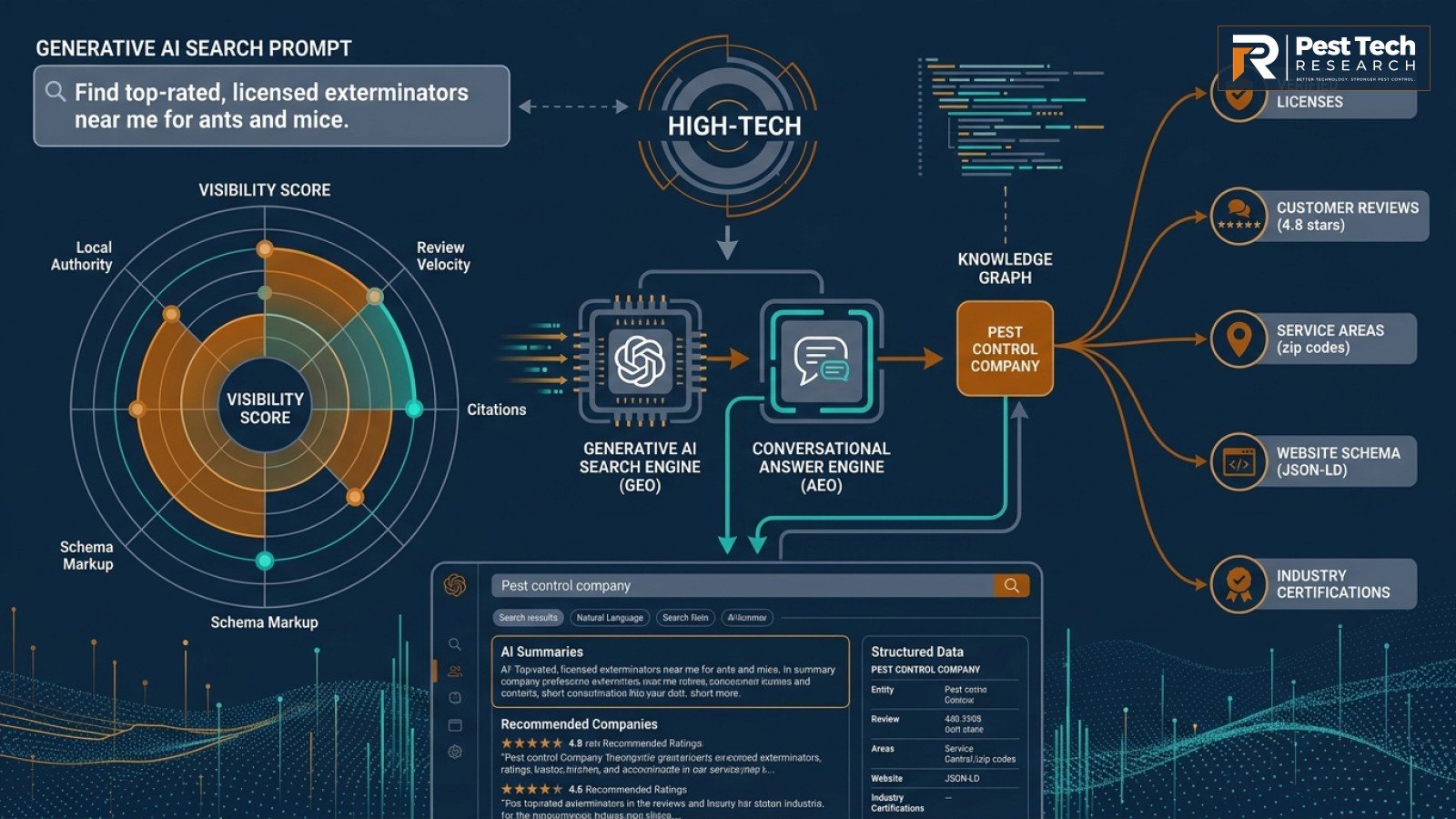
In 2026, generative search engines (such as Google AI Overviews and ChatGPT Search) retrieve and synthesize local business information based on entity understanding, factual consistency, and verified first-party evidence rather than traditional keyword repetition. To maintain visibility, pest control companies must optimize what search models can extract and verify: explicit service area zip codes, specific pest treatments, certified applicator licensing credentials, transparent pricing structures, structured schema markup, and authentic customer reviews. Operators should ignore speculative “rank #1 in AI” agency promises and focus on verifiable digital infrastructure.
- Answer Engines vs Link Lists: AI search models summarize recommendations directly in the interface; homeowners only click sources cited as authoritative entities.
- Entity Grounding is King: Search models verify your business identity across Google Business Profile, state structural licensing registries, BBB, and industry directories (NPMA).
- First-Party Evidence Earns Citations: Content containing original pricing math, specific chemical methodologies, and detailed service workflows is cited far more frequently than generic 500-word blog posts.
- Schema Markup is Essential: Implementing structured `LocalBusiness`, `PestControlService`, and `ServiceArea` JSON-LD schema feeds structured facts directly to AI retrieval bots.
The Evolution from Keywords to Entities
For fifteen years, local SEO for pest control followed a predictable playbook: build city-specific landing pages, repeat the phrase “pest control in [City Name]” in H2 tags, and acquire directory backlinks.
In 2026, search algorithms have shifted from string-matching to semantic entity retrieval. When a homeowner asks an AI assistant: “Who is the most reputable exterminator near me for subterranean termites that uses eco-friendly perimeter bait stations?”, the engine does not merely match keywords. It constructs a knowledge graph of local businesses, evaluating their verified licenses, customer review sentiments, specific service offerings, and pricing transparency.
What AI Search Models Look For: The 4 Evidence Pillars
1. Verified Entity Grounding Across Authoritative Registries
AI search models require confidence that your business is a legitimate, insured, licensed physical entity. They cross-reference your Name, Address, Phone (NAP), and credentials across:
- State Department of Agriculture or Structural Pest Control Board licensing databases.
- Your verified Google Business Profile and Apple Business Connect listings.
- Industry association rosters (such as the National Pest Management Association – QualityPro).
- Better Business Bureau and local Chamber of Commerce records.
2. Direct, Extractable Answers (AEO / GEO)
Generative engines pull information that directly answers the user’s intent. Pages with long, fluffy introductions are ignored in favor of direct, structured explanations:
Poor Content (Ignored by AI): “Pests can be a big problem for families. If you are wondering about termites, you are not alone. Call us today!”
Extractable Content (Cited by AI): “Subterranean termite treatments in North Dallas typically cost between $1,100 and $2,800 depending on linear foundation footage. Our treatments utilize Termidor SC perimeter liquid barriers backed by a 5-year transferable structural warranty.”
3. Structured Data & Technical Schema
Search engines process JSON-LD structured data with 100% precision. Pest companies should deploy rich schema defining:
- `@type: PestControlService` (a specific sub-type of LocalBusiness).
- `areaServed`: Explicit list of postal codes and municipalities.
- `hasOfferCatalog`: Itemized list of service packages (Quarterly Pest, Bed Bug Heat, Termite Baiting).
- `knowsAbout`: Specific pest species treated (*Coptotermes formosanus*, *Cimex lectularius*).
4. Review Sentiment and First-Party Customer Evidence
Modern search systems evaluate review text rather than star ratings alone. An AI model understands that a review stating “Dave arrived on time, inspected our crawlspace for carpenter ants, and explained the perimeter treatment clearly” carries far more entity weight than a generic 5-star rating with no text.
| Search Optimization Factor | Traditional Local SEO | 2026 AI / Generative Search | Action Required |
|---|---|---|---|
| Primary Goal | Rank in top 3 blue links or local pack. | Be cited as the recommended solution in AI synthesis. | Publish verified, fact-dense direct answers. |
| Content Format | Keyword-dense 800-word city landing pages. | Structured workflows, pricing frameworks, and service specs. | Replace thin marketing copy with technical specifications. |
| Licensing & Credentials | Footer mention or ignored. | Critical entity validation signal. | Display state license numbers prominently on every page. |
| Schema Implementation | Basic Organization schema. | Rich `PestControlService` + `OfferCatalog` schema. | Implement granular JSON-LD code on all service pages. |
What Operators Can Actually Control: The Pragmatic Checklist
Do not waste money on marketing agencies promising secret “AI ranking algorithms.” Focus on fundamentals that build genuine digital authority:
- Audit Your Google Business Profile: Ensure every target pest is listed under your primary and secondary service categories. Upload genuine photos of branded trucks, uniformed technicians, and equipment.
- Publish Transparent Pricing Frameworks: While custom jobs require on-site estimates, publishing starting prices (e.g., “Residential quarterly pest programs starting at $45/month”) gives AI search engines the concrete facts they need to recommend your business.
- Document Methodology and Standards: Following the principles of our own Research Methodology, publish your company’s safety standards, environmental protocols, and inspection checklists.
- Google Search Central: Guidelines for Search Generative Experiences and Local Entity Retrieval (Verified 2026).
- Schema.org Documentation: LocalBusiness and HomeAndConstructionBusiness Sub-types.
- Pest Tech Research Local Entity Audits across 50 Regional Pest Markets (Q1-Q3 2026).