
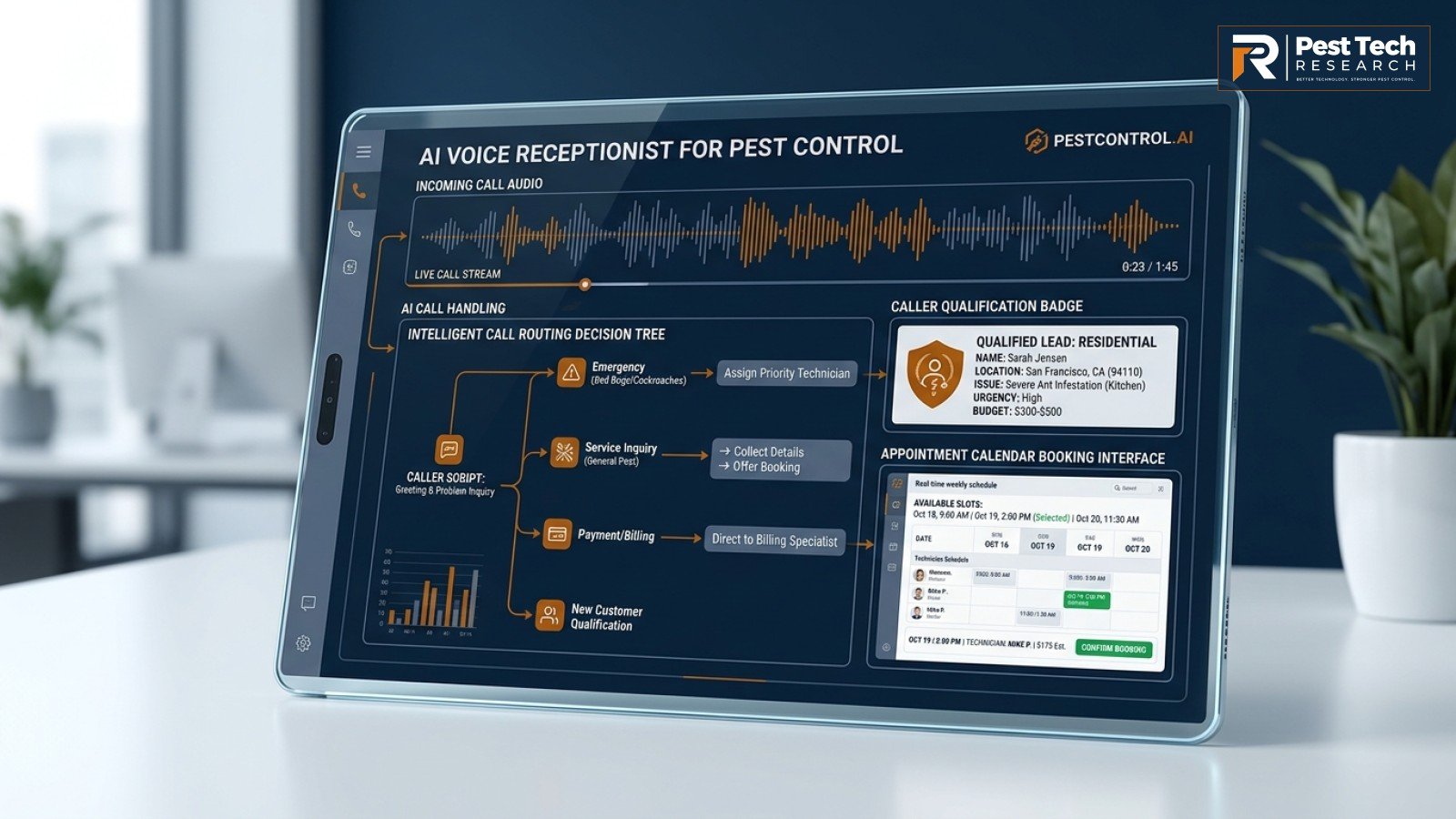
An AI receptionist for pest control can successfully automate 60% to 75% of routine inbound phone volume, including residential inspection booking, missed call triage, after-hours service inquiries, basic pricing questions, and appointment rescheduling. However, it cannot reliably handle high-stakes commercial contract negotiations, customer billing disputes, emergency chemical concerns, or complex structural termite warranties. Successful deployment requires strict human escalation protocols and direct API calendar integration with your CRM.
- Call Volume Separation: Roughly 70% of inbound pest calls follow predictable conversational paths (pest type, location, availability, pricing tier).
- Zero Voicemail Abandonment: Callers who reach an AI voice agent convert at 4x the rate of callers directed to traditional voicemail boxes.
- Mandatory Escalation Rules: The voice agent must have hardcoded transfer logic for stinging insect emergencies, chemical safety questions, and angry customers.
- Two-Way Calendar Sync: An AI receptionist must respect technician service zones, capacity buffers, and appointment windows inside your CRM.
Why Pest Control Companies Are Deploying AI Receptionists
In residential pest control, inbound phone calls are the lifeblood of customer acquisition. However, the operational reality of running a growing pest company creates constant phone bottlenecks:
- Office staff are busy processing invoices, managing dispatch, or speaking with existing clients.
- Technicians in the field cannot safely answer phones while wearing protective equipment or treating attics.
- Peak inquiry surges occur between 7:00 AM – 8:30 AM and 5:30 PM – 9:00 PM, when traditional office desks are unstaffed.
According to research conducted across our Missed Call Revenue Calculator, an average 4-truck pest business misses 15 to 30 calls per week. Because 80%+ of residential callers with an active pest infestation immediately dial the next competitor rather than leaving a voicemail, missed calls represent an enormous leak in company profitability.
The 4 Call Types AI Can Automate Completely
1. New Residential Service Inquiries & Inspection Booking
When a homeowner calls asking, “Do you treat for wasps?” or “How much is a general pest treatment?”, the AI voice agent executes a structured qualification protocol:
- Confirms service area by asking for the property zip code or street address.
- Identifies target pest (ants, spiders, wasps, mice, roaches).
- Asks basic property qualification questions (single family home, square footage range, pets on premises).
- Provides standard baseline pricing or inspection windows approved by management.
- Accesses CRM scheduling slots and books the appointment directly.
- Transmits an instant confirmation text to the caller’s mobile number.
2. After-Hours and Weekend Triage
Rather than letting after-hours calls dump into a dead voicemail box, the AI receptionist operates 24/7/365. It differentiates between routine requests (booking a routine quarterly service for next Tuesday) and urgent emergencies (bats inside a living space or severe rodent activity), flagging on-call technicians only when genuine criteria are met.
3. Routine Appointment Rescheduling
Existing residential subscribers frequently call to shift their exterior treatment by a day or request technician gate-code updates. AI receptionists authenticated via phone caller ID can look up existing records and execute simple calendar adjustments without human intervention.
4. Common Service FAQs
Queries such as “Do I need to leave the house during treatment?”, “Is the exterior spray safe for my dog once dry?”, and “What payment methods do your technicians accept?” are answered instantly using an operator-approved knowledge base.
| Inbound Call Scenario | Automation Suitability | Recommended Action | Escalation Trigger |
|---|---|---|---|
| New Residential Quarterly Pest | 95% Automatable | Qualify address, offer 2 calendar slots, book stop. | Custom square footage > 6,000 sq ft. |
| Bed Bug Inspection Request | 80% Automatable | Explain prep sheet requirements, book paid inspection. | Multi-family property or active tenant dispute. |
| Commercial Restaurant / Warehouse | 25% Automatable | Collect facility details, square footage, contact name. | Transfer immediately to Commercial Account Exec. |
| Billing / Credit Card Update | 70% Automatable | Send secure SMS link to customer payment portal. | Disputed past-due invoice or cancellation threat. |
| Chemical Safety Concern | 0% Automatable | Immediate human transfer; provide EPA SDS contact. | Mandatory emergency transfer protocol. |
The 4 Call Scenarios AI Must Never Handle Alone
Deploying an AI receptionist without strict guardrails is a severe operational mistake. Operators must hardcode immediate human transfer triggers for:
- Commercial & Industrial Bids: Commercial pest contracts require detailed facility walk-throughs, logbook review, and customized IPM specs. The AI should capture the prospect’s contact info and alert the commercial estimator.
- Chemical Exposure or Pet Ingestion Concerns: If a caller states a pet ingested bait or a child touched wet spray, the agent must instantly provide emergency instructions and route to on-call management.
- Cancellations & Retention Risks: An unhappy subscriber threatening cancellation requires empathetic human negotiation and service technician review.
- Complex Structural Termite Warranties: Drilling slabs, liquid barriers, and bait system installations involve specific architectural considerations that cannot be quoted over an automated phone script.
CRM Integration: How Real-Time Booking Operates
An AI answering system that only emails a sound recording or transcript to your office is nothing more than an expensive answering service. True operational automation requires two-way CRM integration:
- Read Availability: The AI queries your software’s scheduling API (FieldRoutes, GorillaDesk, Jobber) to identify open arrival windows within the customer’s specific geographic route cluster.
- Buffer Enforcement: The AI respects route drive-time buffers so technicians are not forced into unrealistic cross-town commutes.
- Lead Record Creation: The AI creates a validated contact record with street address, phone number, audio recording, and transcript attached.
Frequently Asked Questions
What does an AI receptionist cost for a pest control business?
Most providers utilize a hybrid pricing model: a base software subscription ($99–$350/month) plus usage fees ($0.15–$0.35 per conversational minute). At 300 minutes per month, total cost typically ranges from $150 to $450/month—a fraction of a full-time office salary ($3,200+/month) or traditional answering service bill. Calculate your company’s projected ROI using our AI Receptionist ROI Calculator.
Can the AI transfer calls to my cell phone when I’m on call?
Yes. Leading telephony AI platforms support warm and cold call forwarding. If a caller requests an emergency on-call technician or triggers an escalation rule, the AI places the caller on brief hold and dials your mobile phone, announcing the caller’s name and issue before bridging the call.
- Pest Tech Research Benchmark Study: Inbound Call Capture and Voicemail Abandonment in Residential Field Services (2025/2026).
- Telephony LLM Latency Audits across Twilio, Retell, and Vapi Voice Pipelines (Verified September 2026).
- Field Service CRM Public API Documentation: FieldRoutes API v2, GorillaDesk Webhooks, Jobber GraphQL API.