

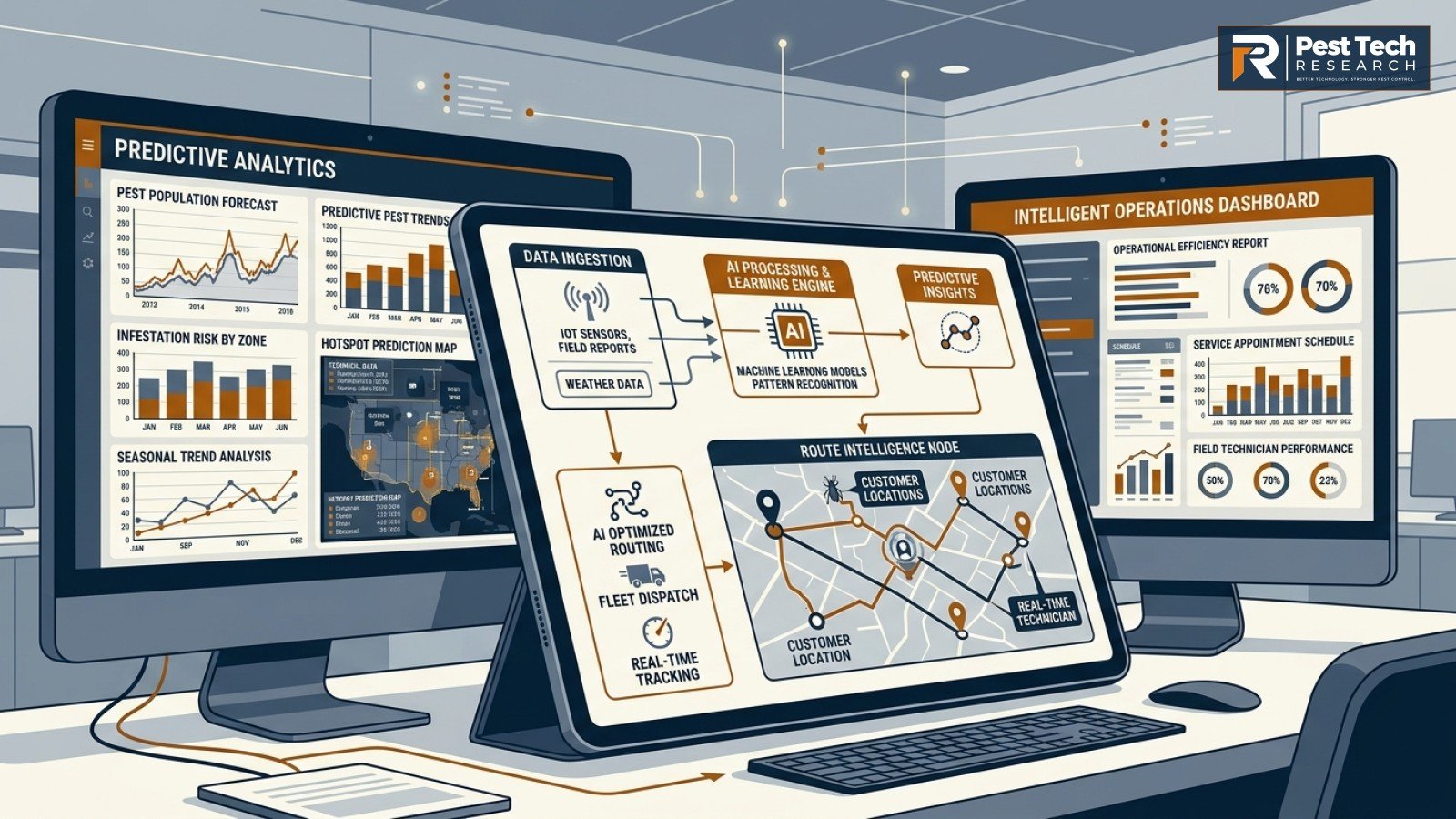
In 2026, artificial intelligence in pest control delivers verifiable ROI in three specific operational workflows: inbound phone call capture (after-hours and overflow triage), automated speed-to-lead follow-up (SMS cadences for web inquiries), and dynamic dispatch optimization. Conversely, AI tools cannot legally or reliably diagnose pest infestations from low-resolution photos, prescribe restricted chemical treatment rates under EPA/FIFRA regulations, or replace licensed human technicians in the field. Operators must demand verifiable integration proof rather than generic vendor promises.
- Voice Automation is Ready: Natural-language voice agents now handle residential inbound call triage, emergency screening, and calendar bookings with sub-second latency.
- Strict Regulatory Boundaries: Federal FIFRA standards and state structural pest control boards require licensed certified applicators for all chemical treatment determinations—AI cannot prescribe dosage.
- Speed-to-Lead Payoff: Automated SMS and voice response within 2 minutes converts up to 391% more pest inquiries than delayed human callbacks.
- Integration is the Real Bottleneck: An AI tool is only as effective as its two-way webhook integration with your core CRM (FieldRoutes, PestPac, GorillaDesk, or Jobber).
The AI Landscape in Pest Control: Reality vs. Marketing Claims
Over the past 24 months, almost every major field service management vendor and telephony provider has slapped an “AI-Powered” badge on their homepage. For a pest control business owner balancing vehicle fuel costs, technician retention, and seasonal call surges, cutting through vendor hype is essential.
At Pest Tech Research, our evaluation methodology evaluates technology purely on operational output: Does it increase billable stops? Does it reduce uncaptured revenue? Does it protect regulatory compliance?
To evaluate AI claims objectively, we divide pest operations into three capability tiers: commercially verified, conditional automation, and regulatory non-starters.
| Operational Capability | Status (2026) | Evidence Level | Real Operational Impact |
|---|---|---|---|
| Inbound Voice Call Triage | Commercially Viable | Verified | Captures after-hours calls, screens emergency termite/rodent calls, books standard general pest visits. |
| Speed-to-Lead SMS Cadence | Commercially Viable | Verified | Instantly texts web inquiries and Google LSA leads within 90 seconds, securing appointments before competitors answer. |
| Dynamic Route Rescheduling | Conditional | Verified | Reorders daily stops based on real-time traffic; requires dispatcher oversight for technician licensing constraints. |
| Automated Quoting via Computer Vision | Vendor Claim | Vendor Claim | Home square-footage estimates from satellite data work; insect identification from homeowner smartphone photos remains error-prone. |
| Chemical Application Prescription | Restricted / Prohibited | Verified | Prohibited by EPA FIFRA regulations; certified applicator license required for active ingredient and dosage calculations. |
What Actually Works: 3 High-Impact Workflows
1. After-Hours and Overflow Call Capture
The single highest-ROI application of artificial intelligence in residential pest control is voice telephony automation. Historically, pest operators relied on answering services (which cost $1.50–$3.00 per minute and frequently took inaccurate messages) or voicemail (which 80%+ of frantic residential callers abandon).
Modern specialized AI receptionists for pest control utilize low-latency large language models combined with conversational speech synthesis. When a homeowner calls at 9:30 PM about rats scratching in their crawlspace, the system answers on the first ring, collects the address, determines property ownership, checks technician calendar availability in the CRM, and books a Friday morning inspection.
2. The Multi-Touch Lead Revival Cadence
Pest control leads decay rapidly. If a homeowner requests an estimate for a quarterly general pest program online, their intent drops significantly after 15 minutes. AI workflow engines connected to your website form automatically initiate a 3-touch sequence across SMS and email:
- Minute 1: Immediate personalized SMS acknowledging the specific pest issue and offering direct calendar booking slots.
- Hour 2: Follow-up text if unbooked, providing transparent pricing ranges or inspection details.
- Day 2: Educational prompt addressing common concerns (safety for pets, exterior-only service).
3. Dynamic Density Clustering
While fully autonomous dispatch is still an experimental vendor claim, AI-assisted routing optimization algorithms provide substantial savings. By analyzing traffic historical patterns, service window constraints, and recurring subscription density, modern routing engines group recurring residential stops into geographic clusters, cutting daily windshield time by 18% to 26% based on our operational modeling.
The Regulatory Boundary: Why AI Cannot Replace the Certified Applicator
Under the Federal Insecticide, Fungicide, and Rodenticide Act (FIFRA) and state regulations (such as California SPCB, Texas TDA, or Florida FDACS), chemical recommendations, target pest diagnoses, and application rates carry legal liability. No software or AI vendor carries pesticide applicator licensing. Any vendor claiming their AI “diagnoses pest infestations and prescribes chemical treatment” is exposing your business to severe regulatory penalties.
In pest control, the human-in-the-loop is not just an operational preference—it is a legal mandate. AI tools must be restricted to administrative, scheduling, customer communication, and routing workflows. The physical inspection, pest identification, chemical selection, and application remain strictly human domains.
How to Evaluate AI Vendor Claims: The 5-Point Test
When evaluating any software vendor marketing artificial intelligence in 2026, demand answers to these five questions before signing an agreement:
- What exact CRM endpoints does your AI write to? Does it create a raw lead note, or does it write directly to customer records, custom fields, and the scheduling dispatch grid via verified API webhooks?
- What is the average speech latency on voice calls? If conversation delay exceeds 1,200 milliseconds, callers will interrupt the agent and experience unnatural cadence.
- What happens during customer escalation? When a customer demands a human manager or reports an emergency chemical spill, how does the call transfer operate?
- Where is customer data stored and trained? Is your proprietary customer list or pricing schedule used to train public foundational models?
- What is the per-minute or per-conversation cost? Beware of flat software fees that bundle expensive per-minute telephony charges on backend overages.
Frequently Asked Questions
Can an AI receptionist integrate with legacy software like PestPac?
Integration depth varies. With modern REST APIs (such as FieldRoutes or Jobber), AI systems can read live technician schedules and write confirmed bookings. With legacy systems like PestPac, integrations frequently require dedicated middleware, Zapier webhooks, or API add-on licensing fees. Review our PestPac software analysis for integration specifics.
Do homeowners know they are speaking with an AI?
Best practice is radical transparency. Leading pest operators program their voice agents to introduce themselves clearly: “Hi, thanks for calling Apex Pest Control. I’m an automated assistant who can help you schedule service or reach our on-call team.” Customer satisfaction remains high when the system solves their problem quickly without artificial pretension.
- U.S. Environmental Protection Agency (EPA). Federal Insecticide, Fungicide, and Rodenticide Act (FIFRA) Compliance Guidelines for Structural Pest Applicators. Verified 2026.
- National Pest Management Association (NPMA). Operational Benchmarks and Technology Adoption in Residential Pest Management. 2025/2026 Survey Data.
- Pest Tech Research Internal Benchmarking Suite: Voice Telephony Latency and CRM Integration Protocol Audits (Q1-Q3 2026).