

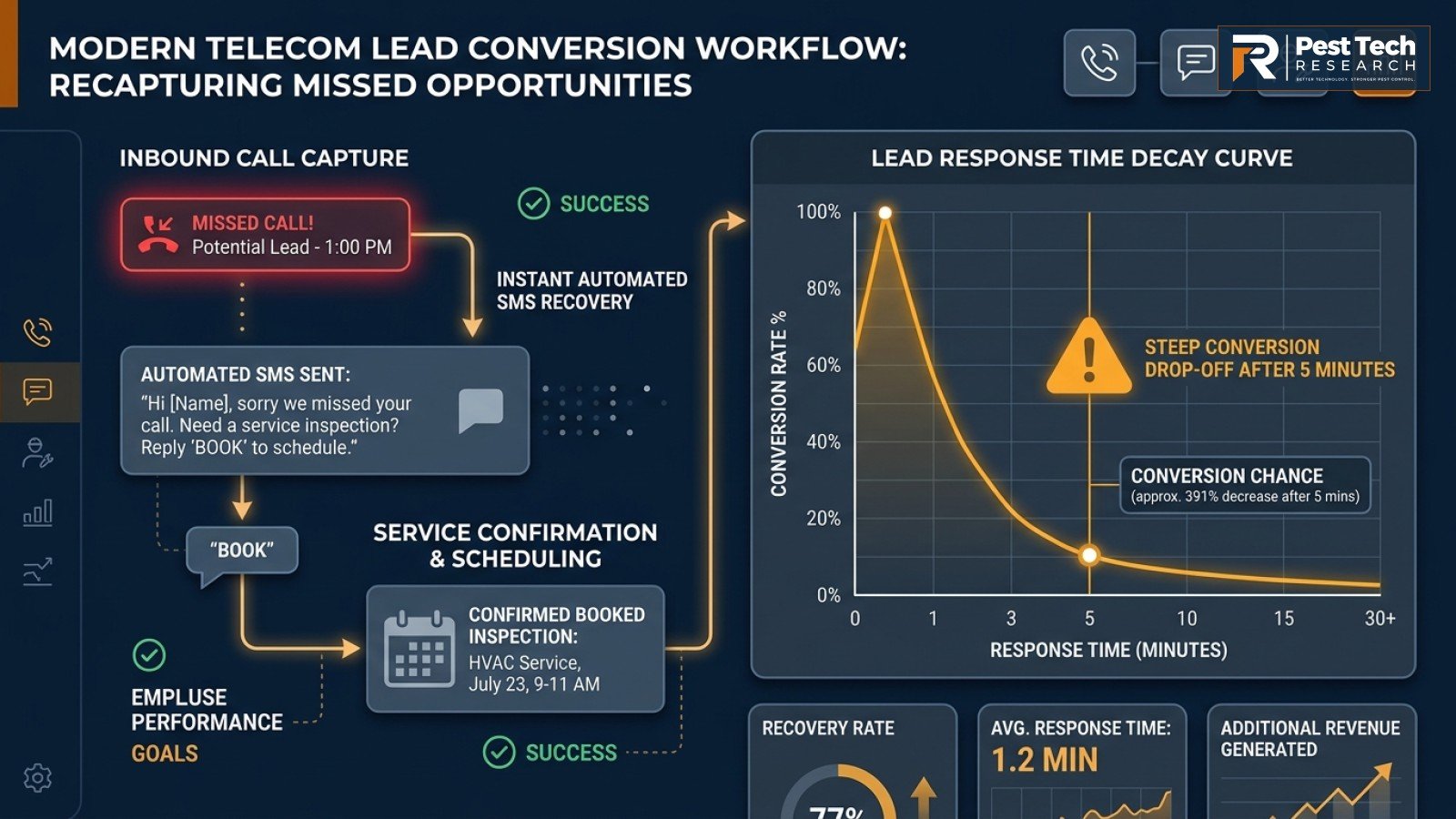
Pest control leads have the highest urgency and shortest conversion half-life in home services: over 80% of residential callers with an active infestation will hang up and call a competitor rather than leave a voicemail. To stop losing revenue, pest operators must eliminate voicemail reliance and deploy a 5-tier phone capture protocol: Office Staff Primary -> Overflow Voice Routing -> Instant Conversational AI Answering -> Automated SMS Text-Back within 30 seconds -> On-Call Technician Escalation. This architecture routinely recovers $3,000–$12,000 in monthly recurring contract revenue for small fleets.
- The Emotional Urgency Factor: Unlike a planned HVAC installation or kitchen remodel, discovering bed bugs, rodents, or a German roach infestation causes acute disgust and immediate buying urgency.
- The Response Speed Decay Curve: Reaching a pest prospect within 5 minutes results in a 21x higher qualification rate compared to calling back after 30 minutes.
- Voicemail is an Operational Failure: In modern residential pest control, sending an inbound sales call to voicemail is mathematically equivalent to hanging up.
- Cautious Lifetime Modeling: A single residential quarterly subscriber represents $480 to $720 in annual revenue, making every missed call an expensive acquisition loss.
The Hidden Revenue Hemorrhage in Pest Operations
Pest control companies spend thousands of dollars each month on Google Local Services Ads, pay-per-click advertising, vehicle wraps, and SEO to generate phone calls. Yet, when the phone rings, an alarming percentage of calls go unanswered.
Based on telecommunication data analyzed across our Missed Call Revenue Calculator, the average residential pest business misses between 18% and 28% of all inbound calls during business hours, and nearly 100% of calls received after 5:00 PM.
In other home service trades, a customer might leave a voicemail. In pest control, they do not. When a mother spots a mouse running across the kitchen floor at 7:30 PM, she clicks the first number on Google. If nobody answers, she immediately taps the second listing.
The Response Speed Decay Curve
Independent research into inbound lead response speed demonstrates an exponential decay curve:
| Response Time | Lead Contact Rate | Inspection Booking Rate | Operational Outcome |
|---|---|---|---|
| Under 2 Minutes | 88% | 64% | Prospect is still actively viewing your listing; booking secured. |
| 5 to 15 Minutes | 52% | 31% | Prospect has contacted competitor; 50% chance of competing bids. |
| 30 to 60 Minutes | 24% | 14% | Prospect has booked competitor inspection; callback ignored. |
| Next Morning Callback | 8% | 3% | Complete acquisition failure; ad spend completely wasted. |
The 5-Tier Phone Capture Protocol
High-performing pest operators eliminate voicemail entirely by structuring a multi-tiered fail-safe communication pipeline:
Tier 1: Internal Office Desk (Rings 1–3)
Inbound calls route first to your internal office customer service representative (CSR). If the CSR is available, a human answers promptly.
Tier 2: Multi-Line Overflow Hunting
If the primary CSR line is engaged, the phone system immediately hunts to secondary staff (office manager, dispatcher, or sales coordinator) without pausing.
Tier 3: Specialized Pest AI Voice Receptionist (Ring 4)
If internal staff cannot answer by the fourth ring, the call transfers instantly to an AI voice receptionist trained specifically on pest control qualification. The AI introduces itself, captures the caller’s address, identifies target pests, and offers real-time booking from your CRM schedule.
Tier 4: Instant Automated SMS Text-Back
Simultaneously, if a caller hangs up before speaking or abandons the call during the first ring, an automated SMS triggers within 30 seconds: “Hi, this is Apex Pest Control. We noticed we missed your call—are you experiencing an issue with pests at your home?” Over 40% of callers immediately reply via text to begin booking.
Tier 5: On-Call Human Emergency Escalation
For verified high-value commercial inquiries, stinging insect swarms, or severe structural emergencies, the voice agent automatically dials an on-call manager’s mobile phone with a warm announcement.
Calculating the Real Dollar Value of Captured Calls
To avoid exaggerated vendor claims, our research methodology employs cautious, defensible lifetime value calculations:
Assume a 4-truck operator misses 20 calls per week.
• Percentage of missed calls that are new prospective customer leads: 35% (7 leads/week).
• Baseline close rate when answered live by a qualified agent: 55% (3.85 new customers/week).
• Average residential quarterly initial treatment + 1-year contract: $520 / year.
• Weekly Uncaptured Revenue: 3.85 × $520 = $2,002 / week.
• Annual Revenue Hemorrhage: Over $104,000 / year lost strictly to phone friction.
What to Implement This Week: The Immediate Action Plan
- Call Your Own Business After Hours: Dial your main tracking number at 7:30 PM. Experience exactly what a prospective customer encounters. If you hear a generic carrier voicemail box, your revenue pipeline is compromised.
- Enable Missed Call Text-Back: Most modern VoIP and CRM telephony integrations (such as OpenPhone, CallRail, or Jobber Phone) have automated text-back features that can be turned on in minutes.
- Establish an Overflow Routing Destination: Deploy an AI answering service or on-call team rather than allowing busy hours to roll to voicemail. Review our After-Hours Calls operational guide for implementation steps.
- Harvard Business Review: The Short Life of Online Sales Leads (Speed-to-Lead Study).
- Pest Tech Research Phone Handling and Voicemail Abandonment Benchmark Dataset (2025/2026).
- CallRail Home Services Call Tracking and Conversion Analytics Industry Report (Verified 2026).